 blog
Are Best Life Peptides Worth It? A Closer Look
Last Updated: October 25, 2026
Quick Summary
Best Life Peptides are research-use compounds offered through Your Best Life MD with physician oversight and personalized health planning for adults exploring recovery, energy, or healthy aging. Vetting matters more than reviews: match the COA lot number to your vial and verify the testing lab independently. Buying from a supplier that won't name its testing laboratory is the clearest red flag in this market.
- Reviews describe a provider experience, not the purity of a vial.
- Match the COA lot number to the vial label character for character.
- A credible COA reports both an HPLC purity figure and mass spectrometry identity confirmation.
- Contact the testing laboratory using details from its own website, not the supplier's page.
- Ask every supplier which lab tested the lot and for the written returns policy.
Table of Contents
- What Are Best Life Peptides and Who They're For
- What Best Life Peptides Reviews Actually Tell You
- How to Read a Peptide Certificate of Analysis
- Research Peptides Safety: What the Labels Don't Tell You
- FDA-Approved Peptides vs. Research-Use Compounds
- Comparing Peptide Providers on Testing, Support, and Returns
- Book a Peptide Consultation at Your Best Life MD
- Frequently Asked Questions
What Are Best Life Peptides and Who They're For
Best Life Peptides are a category of research-use compounds. Your Best Life MD offers peptide therapy with physician oversight and personalized health planning.
Peptides are short chains of amino acids that act as signaling molecules in the body (Cyclic Peptides that Govern Signal Transduction Pathways). In clinical and wellness settings, they're studied for roles in tissue repair, metabolic function, and cognitive health. The research-use market for these compounds has grown quickly, and quality varies enormously between suppliers.
Who they're for: adults working with a licensed provider who want structured, monitored support rather than a self-directed experiment. If you want to see how peptides fit into a broader wellness plan, review the personalized health plans we build around each patient's symptoms and goals. You can also browse the peptides to understand the range of options.
What Best Life Peptides Reviews Actually Tell You
Reviews of peptide providers tend to cluster around three themes: consultation quality, follow-up support, and whether patients felt their protocol was genuinely personalized. The pattern is consistent with what we hear across the peptide industry.
A common mistake buyers make is treating online reviews as a quality signal for the compound itself. Reviews describe an experience with a provider, not the purity of a vial.
What most guides miss is that negative reviews often reveal more than positive ones. Look for complaints about unclear dosing instructions, slow responses to questions, or vague answers about sourcing.
How to Read a Peptide Certificate of Analysis
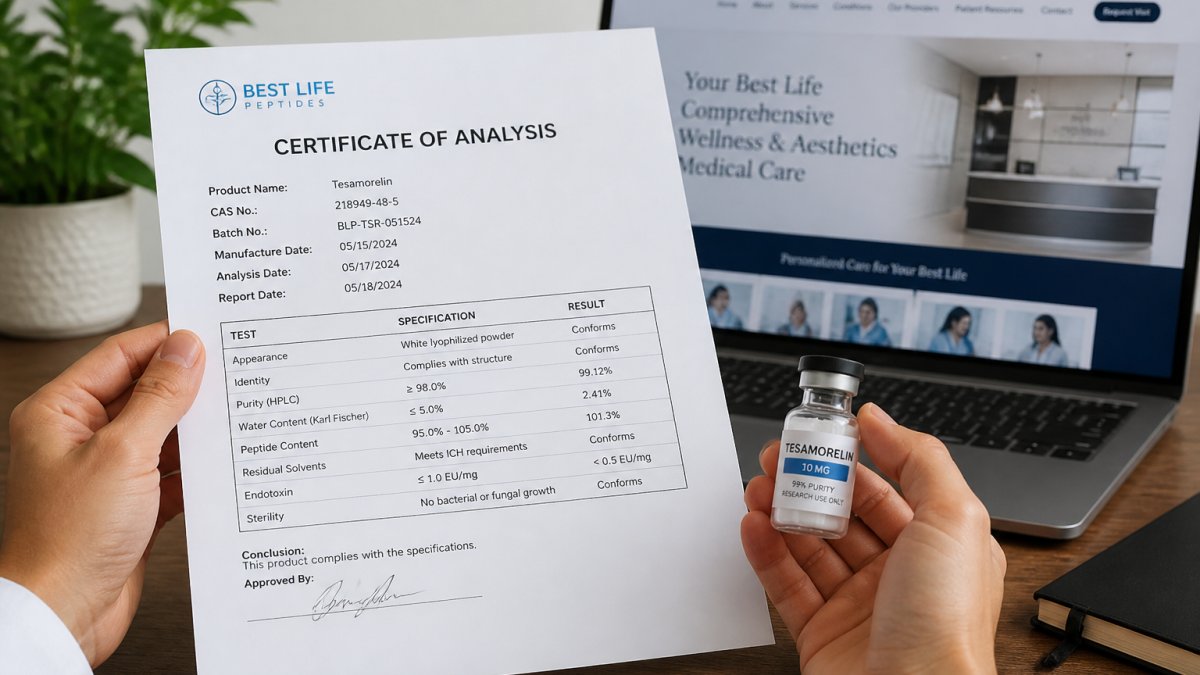
A peptide certificate of analysis is a document from a testing laboratory that reports the identity, purity, and sometimes sterility of a specific batch of compound. Reading one correctly is the single most useful skill a peptide buyer can develop, and the one most guides skip past.
Here's what to check on any COA:
- Batch or lot number that matches your vial
- Test date within a reasonable window of the batch's manufacture
- Purity figure from a named analytical method, typically HPLC
- Mass spectrometry confirmation of molecular identity
- Laboratory name and contact details you can independently verify
- Residue and sterility results where applicable
Matching the COA Batch Number to the Vial
The batch number is where most verification efforts fail. A supplier can publish a beautiful COA for a batch that has nothing to do with the vial in your hand. Match the lot number on the certificate to the lot number printed on the vial label, character for character.
The next step is contacting the laboratory directly using contact details from its own website, not from the supplier's page. Ask whether the certificate number is genuine. This takes a few minutes and eliminates most of the risk.
Reading the Assay Method, Not Just the Purity Number
A purity figure without a method is a marketing number. HPLC (high-performance liquid chromatography) separates components in a sample and reports the relative area of the main peak as a percentage.
Mass spectrometry (MS) is the identity check. HPLC can show a single clean peak for the wrong molecule; MS confirms the molecular weight matches the expected peptide. A credible COA reports both, and the two should agree. If a certificate shows only a purity percentage with no method and no mass confirmation, treat it as incomplete.
Judging Laboratory Independence
The value of a COA depends entirely on who produced it. An in-house lab run by the supplier is not independent verification, it is a self-report.
A common pattern among weaker suppliers is a COA with a lab name that returns no search results, no website, and no phone number. That is not proof of fraud, but it is a reason to walk away.
What a COA Cannot Tell You
Even a perfect certificate has limits. It describes the sample that was submitted, not every vial in the batch. It does not confirm how the compound was stored or shipped. And it does not establish safety for human use, purity and safety are different questions. Use the COA to rule out obvious problems, then rely on provider oversight and your own risk assessment for everything it cannot cover.
Research Peptides Safety: What the Labels Don't Tell You
Research peptides safety is not a settled topic, and any provider who implies otherwise is overselling. Most compounds sold for research use have limited human trial data. That doesn't make them dangerous by default, but it does mean the evidence base is thinner than what you'd expect from a prescription drug.
Three things labels rarely tell you:
- Purity isn't the same as safety. A 99% pure compound can still be the wrong compound, or carry contaminants the assay didn't test for.
- Research-use labeling shifts responsibility to you. These products are not approved for human consumption, and that designation is not a marketing formality.
- Storage and handling affect stability. Improper shipping conditions can degrade a compound before it reaches you.
Watch out: buying from a supplier that won't name its testing laboratory is the clearest red flag in this market. If they can't tell you who tested the batch, assume no one did.
FDA-Approved Peptides vs. Research-Use Compounds
The FDA has approved a small number of peptide-based drugs for specific medical conditions, and those approvals come with clinical trial data, manufacturing standards, and prescribing controls.
That distinction matters for how you read marketing claims. A supplier saying its compound is "pharma grade" is making a claim the FDA has not evaluated.
For current guidance on which peptides are approved and what the rules are, check the FDA's page on unapproved drugs and peptide products directly. It's updated more reliably than any reseller's FAQ page.
Comparing Peptide Providers on Testing, Support, and Returns
Provider comparison comes down to more than a checklist, and most buyers only check price and a purity number. A useful comparison is reproducible: you should be able to run the same evaluation on any supplier and get a defensible answer. Here is the framework we would use, and how to apply it.
| Criterion | What to Look For | How to Verify It | Why It Matters |
|---|---|---|---|
| Third-party testing | Named lab, per-batch COA | Contact the lab directly using its own published details | Confirms identity and purity independently |
| Batch consistency | Lot numbers traceable across orders | Compare lot numbers on repeat orders | Stable dosing over time |
| Clinical support | Licensed provider available for questions | Ask who answers questions and when | Catches contraindications early |
| Returns policy | Written terms before purchase | Request the policy in writing pre-purchase | Limits financial exposure |
| Payment security | Standard encrypted processing | Confirm the checkout uses HTTPS and a recognized processor | Protects card data |
A Reproducible Comparison Method
Pick three to five suppliers and evaluate each on the same criteria on the same day. Record what you checked and when. For testing, request the COA for the specific lot you would receive and verify the lab independently. For support, send the same question to each supplier and note response time and whether the answer is specific or generic. For returns, ask for the written policy before you buy, a policy that only appears after a problem is not a policy. This method is not glamorous, but it produces a comparison you can trust more than any ranking page.
Returns, Payment Security, and Support
These are the practical concerns buyers raise after the sale, and they are rarely covered in comparison content. On returns, look for written terms that state what is refundable, what is not, and the time window, research materials are often sold with limited return rights, so know the terms before purchase. On payment, confirm the checkout uses standard encrypted processing and a recognized payment provider; avoid suppliers that request unusual payment methods with no recourse.
Pricing and Cost per Milligram
Pricing deserves its own note. Cost per milligram varies widely, and a cheap vial often reflects skipped testing rather than efficiency. Ask what testing is included before comparing price per milligram across suppliers, and compare only after you have confirmed the testing and documentation are equivalent. A lower price on an untested product is not a lower price, it is a different product.
For readers who want to review our peptide service details and options side by side, the peptides page lays out what we offer.
Book a Peptide Consultation at Your Best Life MD
The gap between a good peptide experience and a bad one usually comes down to supervision.
At Your Best Life MD, our certified physicians and medically supervised nurse practitioners build recommendations from a symptom assessment rather than a product list.
If you're ready to talk through whether peptides fit your situation, book a consultation or reach out through our contact page to schedule. Bring your questions about testing, sourcing, and what monitoring looks like.
Frequently Asked Questions
What are Best Life Peptides, and are they legitimate?
Legitimacy of research-grade peptide compounds depends on the individual vendor. Before buying, ask for a batch-specific certificate of analysis from an independent laboratory, confirm the COA matches the vial's lot number, and check whether the seller states clearly that its products are for research use only. A provider that cannot supply a verifiable COA or that makes human-use claims without FDA approval is a warning sign.
How can I independently verify a peptide certificate of analysis?
Start by checking the COA's issuing laboratory, then look up that lab directly rather than trusting the seller's link. Confirm the report lists the batch or lot number printed on your vial, the analytical method used (such as HPLC for purity and mass spectrometry for identity), and a purity figure with a date. Some labs offer online verification portals where you can enter the report number. If the seller cannot connect a specific vial to a specific test result, treat the certificate as marketing rather than proof.
Are research peptides approved for human use?
Most peptides sold as research chemicals are not FDA-approved for human use and are labeled for laboratory research only. A small number of peptides do have FDA approval for specific medical conditions, but those are prescription products dispensed through licensed pharmacies, not research vials sold online. Using unapproved research peptides carries unknown risks around purity, dosing, and sterility. If you are considering peptide therapy for a health goal, work with a licensed clinician who can assess whether a regulated option fits your situation.
What are the risks of using peptides without medical supervision?
Without supervision, you lose the screening that catches contraindications, the dosing guidance that prevents errors, and the follow-up that flags side effects early. Unverified research peptides may also contain impurities, be under- or over-dosed, or arrive without sterility assurance. Research peptides safety depends heavily on sourcing and oversight. A clinician can review your history, explain what evidence exists for a given compound, and monitor your response, which is something no product listing can do for you.
Peptide decisions get easier when someone qualified is reviewing your history, your goals, and the products in front of you. Your Best Life MD offers physician-led consultations, medically supervised nurse practitioners, and personalized recommendations built from a full symptom assessment at our York and Camp Hill locations. Get started with Your Best Life MD and make your next step an informed one.